Is That a Rat or Mouse in Your Attic?
You don't necessarily have to see the rodent to start narrowing down the possibilities. Look at the evidence it leaves behind.
Droppings: Mouse droppings are small, typically about the size of a grain of rice, while rat droppings are considerably larger. The exact appearance can also vary by species.
Noises: Both rats and mice can make scratching and scurrying sounds as they move through an attic. Because rats are larger, their movement may sound heavier, although sound alone isn't a reliable way to identify the animal.
Gnawing: Rats and mice both have continuously growing incisors, so gnawing is normal rodent behavior. Mouse gnaw marks tend to be smaller, while rats can leave larger, more noticeable damage.
Nesting material: Both may use insulation, paper, fabric, and other soft materials when nesting. Finding a nest confirms that something has been using the space, but the material itself may not tell you whether it's a rat or a mouse.
These clues can point you in the right direction, but identifying an attic rodent becomes easier when you also consider which species are most likely to spend time above ground.
If It's a Rat, Roof Rats Are More Likely in the Attic
Not all rats use a home the same way.
Roof rats are agile climbers and are much more comfortable above ground than Norway rats. Trees, fences, vines, utility lines, and other elevated routes can help them reach a roof. If they find an opening, attics provide the sheltered environment they're looking for.
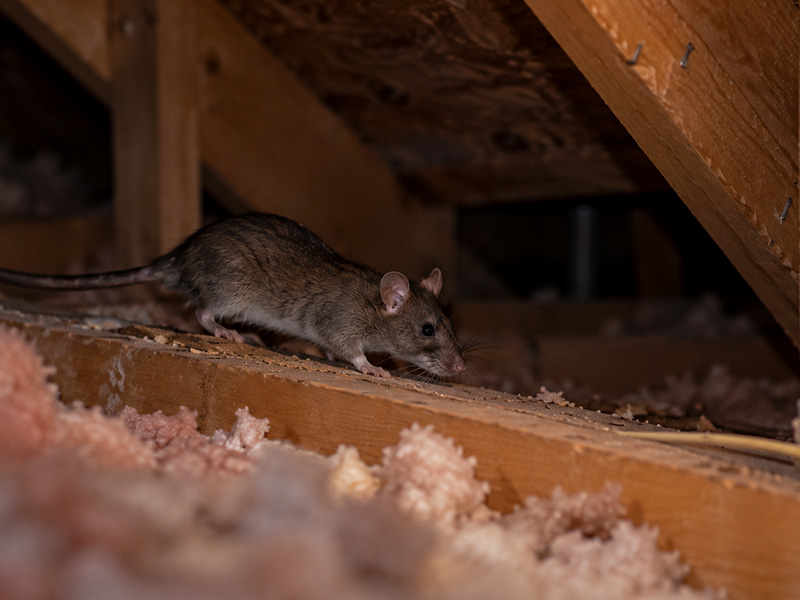
Roof rats have slender bodies, pointed noses, large ears, and tails that are typically longer than their head and body combined. Adults are considerably larger than house mice, although homeowners don't always get a clear enough look to judge size accurately.
If rat activity is concentrated overhead, the climbing habits of roof rats make them an important suspect.
What About Norway Rats?
Norway rats are less closely associated with attics because they spend much more of their time at or below ground level.
These stockier rats are strong burrowers. Around homes and buildings, they're more commonly found near foundations and other lower portions of a structure. Compared with roof rats, they have heavier bodies, smaller ears, blunter noses, and shorter tails.
That doesn't make it impossible for a Norway rat to reach an attic. Rodents can turn up in unexpected places, particularly when a structure gives them a way to move between levels. But when the activity is primarily overhead, a roof rat generally fits the location better than a Norway rat.
Mice Can Live in Attics, Too
A rat isn't the only possibility when you hear something moving overhead. House mice can readily make themselves at home in attics.
Their small size gives them an advantage when entering buildings. A house mouse can squeeze through an opening only about 1/4 inch wide, which means gaps that don't look like possible entrances to us can be large enough for a mouse.
House mice are much smaller than either roof rats or Norway rats. They typically have dusty gray to brown fur, relatively large ears, pointed noses, and thin tails.
Once inside, an attic offers plenty of sheltered areas where mice can hide and nest, particularly among insulation and stored belongings.
If you've noticed evidence of mice in other parts of your home as well, knowing the signs of mice can help you determine how widespread the activity may be.
How Are Rats and Mice Getting Into the Attic?
Finding a rodent in the attic raises another important question: how did an animal that lives outdoors end up above your ceiling?
Rodents don't need an entrance that looks obvious to you. Mice can use extremely small gaps, and rats can take advantage of larger openings around the exterior of a home.
Potential access points can develop around:
- Rooflines
- Soffits and fascia
- Roof and attic vents
- Utility penetrations
- Gaps where different building materials meet
- Damaged or deteriorated exterior areas
- Openings around pipes and other penetrations
Identifying and addressing these access points is essential to dealing with an attic rodent problem. Removing rodents without sealing off potential entry points can leave the home vulnerable to more activity.
What Can Rats and Mice Damage in an Attic?
An attic gives rodents access to materials they can chew, contaminate, or use for nesting.
Rats and mice may disturb or contaminate insulation with urine and droppings. They can gnaw on stored belongings, wood, plastic, and other materials they encounter.
Electrical wiring is a particular concern. Rats and mice can chew the protective covering around wires, potentially damaging the wiring, causing shorts, and creating a fire hazard.
The longer rodents have access to an attic, the more opportunity they have to contaminate materials, damage belongings, and move into other areas of the structure.
Get Rats and Mice Out of Your Attic and Keep Them Out
If rats or mice have made their way into your attic, Bizzy Bee Exterminators can help. We'll determine what you're dealing with and then eliminate the rodents currently in your home.
To help keep rodents from becoming a problem again, we recommend signing up for one of our ongoing home pest control plans. Rats and mice are covered along with a wide range of other common household pests, giving you year-round protection backed by Bizzy Bee's 100% Satisfaction Guarantee.
Bizzy Bee has been locally owned and family-operated since 1972, serving homeowners in Winder, Acworth, and throughout Metro Atlanta and other Georgia communities, as well as Greenville and parts of Upstate South Carolina.
Contact Bizzy Bee Exterminators today to get rid of rodents and protect your home from future pest problems.
Originally published August 15, 2024. Updated October 1, 2026, with new information about identifying rats and mice in attics.