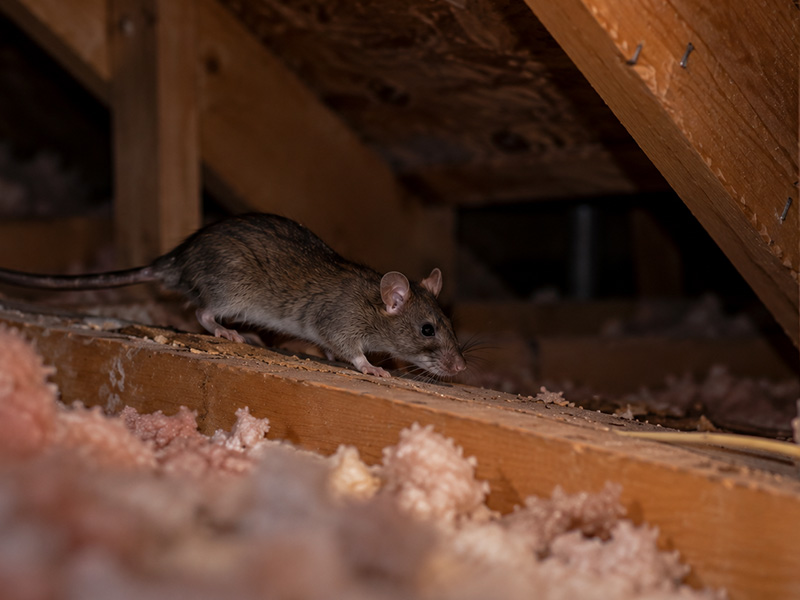
Roof rats are agile, tree-dwelling rodents that commonly invade attics, rooflines, and upper levels of homes. Because they live and travel above your living space, roof rat infestations often go unnoticed until damage has already occurred. Bizzy Bee Exterminators has over 50 years of experience dealing with roof rats and other rodents. We’ve gathered important information you need to identify, prevent, and control these hard-to-detect climbers.
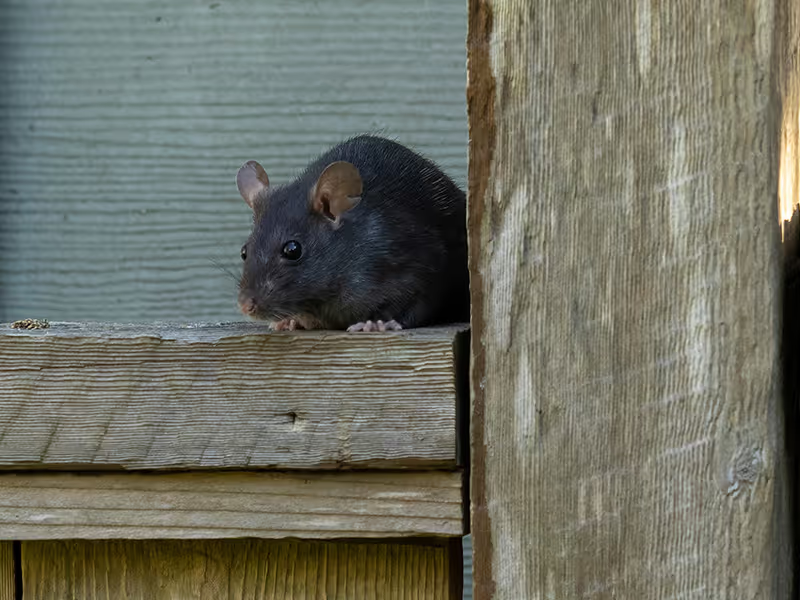
Roof rats (Rattus rattus), also known as black rats or ship rats, are small, slender rodents characterized by their exceptional climbing ability. Unlike ground-dwelling Norway rats, roof rats prefer elevated areas such as trees, roofs, attics, and upper levels of buildings. Their ability to climb and nest above ground makes them particularly challenging to detect and control.
Because roof rats prefer elevated spaces, signs of an infestation are often found above ground level rather than in basements or crawl spaces. Common signs include:
Roof rats thrive in warm climates and areas with dense vegetation, which makes many homes across the Southeast especially attractive. Overhanging tree branches, fences, and utility lines provide easy access to roofs and upper structures. Once inside, roof rats take advantage of quiet attic spaces, insulation, and stored items to build nests and reproduce.
Because winters are generally mild, roof rat activity can continue for much of the year, increasing the risk of ongoing infestations if entry points are not correctly sealed.
Roof rats create serious problems due to their nesting habits. Living in ceilings and attics places them close to electrical wiring, increasing the risk of wire damage and potential fire hazards. Their constant gnawing can also destroy insulation and stored items without being immediately visible.
Additionally, roof rats contaminate attic spaces with their droppings and urine, which can negatively impact indoor air quality and facilitate the spread of bacteria throughout the structure.
Roof rats rarely enter homes at ground level. Instead, they use trees, fences, and utility lines to access roofs and upper openings. Even small gaps can allow entry, including:
Roof rats are challenging to eliminate using store-bought rat traps and other DIY methods due to their climbing ability and tendency to nest in hard-to-reach locations. Professional rodent control is the most effective way to eliminate the infestation and prevent it from returning. Bizzy Bee Exterminators provides targeted roof rat control solutions, and all services are fully guaranteed.
Yes. Roof rats commonly damage electrical wiring, insulation, and stored items in attics, increasing the risk of electrical issues and fire hazards.
Attics provide warmth, shelter, and nesting materials while keeping roof rats hidden from people and predators.
Homeowners often hear scratching, running, or thumping sounds in ceilings or attics, especially at night.
Bites are uncommon, but roof rats may bite if threatened or cornered. Any bite should be cleaned and evaluated by a medical professional.
Both can cause serious damage, but roof rats are often harder to detect because they live above occupied spaces where problems can grow unnoticed.
Roof rat infestations shouldn’t be ignored. If you suspect roof rats in your home or business, contact Bizzy Bee Exterminators. Serving customers throughout the Southeast since 1972, we provide expert pest control with guaranteed results.

Great business. Punctual, professional, and cost-effective. Call Bizzy Bee for all your pest control needs
Dustin H.
Winder, GA.

I have been using BizzyBee at my restaurant for several months now and I am so happy with the overall service. I highly recommend for all your pest needs!
Amanda H.
Winder, GA.

We have been using Bizzy Bee for 10+ years now. Just had our next visit in our new place in Monroe. Cecilia was Very knowledgeable, friendly and courteous. Thank you Bizzy Bee for your services. We recommend this firm for anyone's pest control needs.
Richard K.
Monroe GA.


Helpful Tips & Info